
Uber Has A New Way To Rip Off Its Drivers
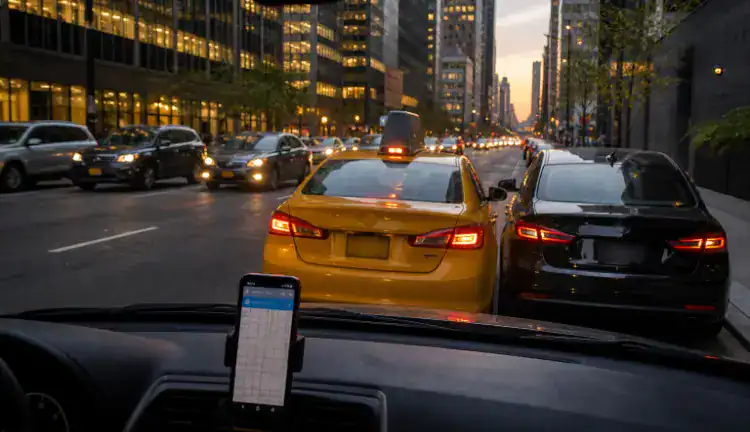
Last year, the ride-sharing giant Uber introduced a new way to expand its driver pool. Uber subsidiary Xchange Leasing, LLC allows drivers with bad credit scores to lease cars at a higher-than-average weekly rate.
With the help of a $1 billion credit facility that includes capital from Goldman Sachs, Citigroup, Deutsche Bank AG, JPMorgan, SunTrust and Morgan Stanley, Xchange offers subprime leases, targeting drivers that have been turned down by traditional lenders.
The Xchange offer is attractive to many drivers because of its minimal down payment and unlimited miles. Uber claims that Xchange is not intended to turn a profit, but rather to increase the number of drivers available.
Uber’s need for more drivers is well documented, with approximately 50% of Uber drivers quitting within 6 months. So far, Xchange has been phenomenally successful at remedying this problem. According to Uber, 100,000 new drivers are on the road this year thanks to Xchange.
But can we really trust Uber’s statement that Xchange is not primarily focused on making money as well?
The credit agency Experian reported the average weekly payment for a new car lease in late 2015 to be $96 per week. Xchange drivers pay between $120 and $160 per week, with a mark-up as great as 350% in some cases.
In addition to charging steep rates, Xchange compensates for riskier borrowers by taking lease payments directly from its drivers’ Uber paychecks. When drivers fail to drive enough trips to make their payments, Xhchange hires repo men to confiscate their cars.
Many drivers that leased cars from Xchange early last year fell behind on payments after Uber slashed its wages over the winter.
“If you were short on your payment for a week it would roll onto the payment for next week. It starts adding up,” described Uber driver Shawn Hofstede, whose Toyota Corolla was repossessed in April.
“I’d say the cost is greater than the benefit for your average driver,” said Boston University business school lecturer Mark Williams. “The terms, the way they’re proposed, are predatory and are very much driven toward profiting off drivers rather than to facilitate an increase in drivers.”
Just in case you thought Xchange’s predatory business practices were a necessary evil to get more drivers on the road, consider Express Drive, the much more driver-friendly car rental program started by Lyft and GM. Express Drive determines its weekly rental rates based on the number of Lyft trips the driver makes, ranging from $99 per week plus 20 cents per mile, to $0 per week for drivers that make over 65 trips.
From charging surge pricing during states of emergency to ordering thousands of fake Lyft rides to sabotage its rival, Uber executives have a long history of unethical behavior.
Hopefully, with enough media coverage and public pressure, Uber will reconsider the terms of its subprime auto-leasing scheme. At the very least, ride-share drivers might think twice before signing up.
Sources: Levi, Ari, “Uber is gearing up to upend the auto loan market,” CNBC, 7 June 2016.
Newcomer, Eric and Olivia Zaleski, “Inside Uber’s Auto-Lease Machine, Where Almost Anyone Can Get a Car,” Bloomberg, 31 May 2016.
Niu, Evan, CFA, “Uber is now actively preying on the poor,” AOL, 5 June 2016.
Somerville, Heather, “Lyft and GM roll out car rental program to attract more drivers,” Reuters, 15 March 2016.
Related Practice Areas
Image note: photographs accompanying our blog articles are illustrative and digitally created. They do not depict actual clients, actual attorneys of this firm, or actual events.
Read more

Beyond the App: Unmasking Uber’s Strategy to Evade Passenger Liability
When a passenger steps into an Uber on the streets of New York, there is an implicit expectation that the multi-billion-dollar ride-hailing giant stands behind the safety of that journey. Yet, in courtrooms and arbitration proceedings across the country, Uber’s primary defense line remains remarkably consistent: we are merely a technology platform, not a transportation […]

When the Safety Net Fails: What Michael Wagner’s Story Teaches NYC Construction Workers About Labor Law 240(1) & Injury Rights
In the immediate aftermath of a severe construction site accident, most injured workers focus on one thing: getting back on their feet. They assume that if they play by the rules, report the incident, and file their claims, the safety net will be there to protect them and their families. Unfortunately, as millions of workers […]

Can New York City Be Liable for a Dangerous Street or Intersection?
When a pedestrian, bicyclist or motorist is seriously injured in a New York City traffic accident, the investigation should not always end with the drivers involved. In some cases, the design, operation or maintenance of the roadway itself may have contributed to the crash. New York City has a duty to maintain its streets in […]