
Highway Guardrail Maker Sold Defective Rails For Years
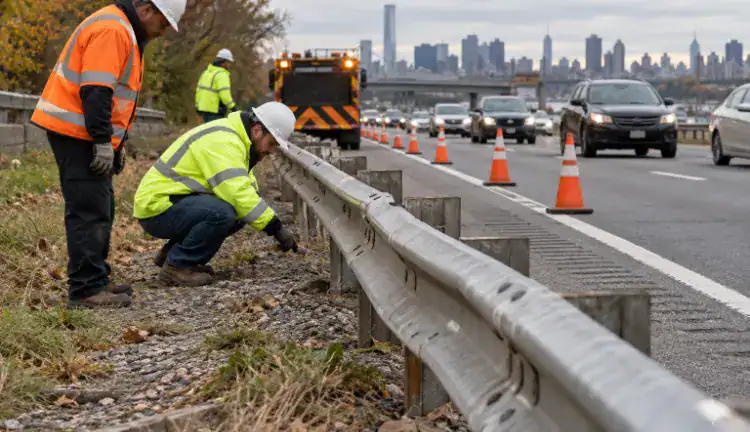
At least nine motorists are dead because of a design change in the highway guardrails produced by Texas-based Trinity Industries Inc.
In 2005, Trinity changed the design of its ET-Plus guardrail systems in order to cut production costs, but in doing so the company created an added danger for the drivers and passengers of cars that collided with the rails.
Trinity was required by law to alert the National Highway Administration (NHWA) of the design change, but it did not. Instead, the company continued to sell its guardrails to state governments under the pretense that the design was the same.
But that was a lie. Testing by the NHWA earlier this year found that Trinity guardrails had “safety performance limitations” in certain crash scenarios. When Virginia’s transportation department ran a crash test on the ET-Plus with a pickup truck, the truck went airborne after the collision.
Highway guardrails exist as safety barriers to protect motorists that veer off the road. The ET-Plus guardrails were designed to collapse in the event of a head-on collision, with the guardrail head sliding back along the sharp rail to divert it from piercing through the car.
You can find a video of design in action here.
However, the redesigned ET-Plus guardrails have a tendency to jam at the head, which causes the razor-sharp rail to impale the colliding car, potentially injuring or killing its passengers.
A whistleblower lawsuit launched in 2012 found Trinity guilty of defrauding the federal government. The case resulted in a $663 million verdict against the company. Additionally, there are presently at least twenty pending personal injury lawsuits filed by individuals that were injured or lost loved ones as a result of the defective guardrails.
Still, Trinity maintains that its failure to alert the government of its design change was not intentional. They have since released a statement implying that they plan to appeal the judge’s decision: “Trinity believes the decision cannot and will not withstand legal scrutiny.”
Regardless of what Trinity says about its intentions in keeping the design change a secret, its decision to alter the ET-Plus was purely financial. By switching over to the redesigned guardrail heads, Trinity saved roughly $2 per head.
To the executives at Trinity, that savings was enough to justify putting the lives of motorists across the country at risk.
Now that the company has been hit with the third largest jury verdict of last year, we hope they think twice before trading safety for profits again.
Sources: Ivory, Danielle and Aaron M. Kessler, “Guardrail Maker Trinity Industries Liable for Fraud in Texas,” The New York Times, 20 October 2014.
Lee, Patrick G and Valerie Reitman, “Virginia’s Guardrail Test in Trinity Fight Sends Pickup Airborne,” Bloomberg, 2 October 2015.
Lee, Patrick G., “Trinity Guardrail Fraud Award Grows to $663 Million,” Bloomberg, 9 June 2015.
Related Practice Areas
Image note: photographs accompanying our blog articles are illustrative and digitally created. They do not depict actual clients, actual attorneys of this firm, or actual events.
Read more

Beyond the App: Unmasking Uber’s Strategy to Evade Passenger Liability
When a passenger steps into an Uber on the streets of New York, there is an implicit expectation that the multi-billion-dollar ride-hailing giant stands behind the safety of that journey. Yet, in courtrooms and arbitration proceedings across the country, Uber’s primary defense line remains remarkably consistent: we are merely a technology platform, not a transportation […]

When the Safety Net Fails: What Michael Wagner’s Story Teaches NYC Construction Workers About Labor Law 240(1) & Injury Rights
In the immediate aftermath of a severe construction site accident, most injured workers focus on one thing: getting back on their feet. They assume that if they play by the rules, report the incident, and file their claims, the safety net will be there to protect them and their families. Unfortunately, as millions of workers […]

Can New York City Be Liable for a Dangerous Street or Intersection?
When a pedestrian, bicyclist or motorist is seriously injured in a New York City traffic accident, the investigation should not always end with the drivers involved. In some cases, the design, operation or maintenance of the roadway itself may have contributed to the crash. New York City has a duty to maintain its streets in […]