
Are E-Bikes Dead in New York?
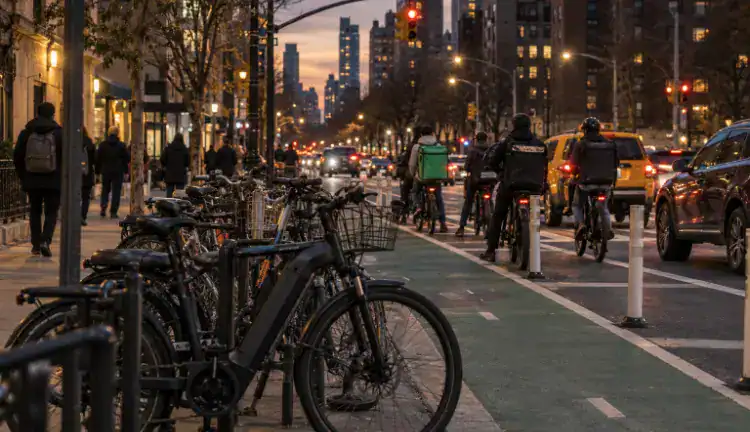
New Yorkers are no strangers to the aggravations of widespread e-bike use. Up until last year, pedestrians frequently dealt with e-bikes taking up the sidewalk, while many drivers experienced e-bike riders heading the wrong way into traffic.
That’s why, after over a decade of virtually unenforceable legislation, New York finally cracked down on e-bike use.
In July of last year, the NYPD was given orders to hand out tickets to e-bike riders with fines up to $500. Between July and October, police issued over 685 summonses for e-bike and motorized scooter use, and seized 96 vehicles.
According to an NYPD document acquired by the New York Daily News, the crackdown sought to promote “public safety by enforcing laws pertaining to the use of motorized scooters/electric bikes.”
New York law requires all motorized vehicles to be registered with the DMV, but makes it impossible to register an e-bike. “Technically they can’t be registered and they can’t be considered bicycles because they are not solely powered by human power,” said a source at the NYPD. “It’s a problem that we get a lot of complaints about. We try to confiscate them as soon as we see them.”
While banning e-bikes altogether may seem like an effective solution for curbing dangerous riding habits in the city, it is no more than a temporary fix for a growing problem.
Like it or not, e-bikes are here to stay. As the recent nationwide hoverboard craze demonstrates, there is a demand for new forms of motorized transportation. New York would do well to stay ahead of the curve by setting clear rules for e-bikes that protect the safety of riders as well as pedestrians.
Many states, including Kentucky, Nebraska and Montana now allow regulated e-bike use. California recently adopted legislation that distinguishes between three classes of e-bikes and specifies rules for each.
New York, however, does not distinguish between fully motorized “throttle” e-bikes and the pedal assist e-bikes commonly used by riders with health limitations to achieve greater mobility. All are equally banned.
Restaurant delivery workers have been hurt the most by the e-bike ban.
Jason Shi is 52-year-old deliveryman who, prior to the crackdown, worked two jobs at 60 hours per week in order to make ends meet. After switching back to a regular road bike, he lost over half his income due to exhaustion. “We are not a criminal,” Mr. Shi said through an interpreter. “We just do delivery work on the street.”
“They’re outlawing a legitimate mode of transportation. Lumping electric assist in with motor scooters is unfair to e-bike users, and it’s not going to serve the mayor’s goals of doubling bicycling by 2020—nor will it serve Vision Zero,” said Paul Steely White, an executive director of the advocacy group Transportation Alternatives.
Sources:
Clark, Ryan, “NYC’s crackdown on e-bikes: What this means for riders, owners,” Multibriefs, 4 August 2015.
Crane-Newman, Molly and Thomas Tracy, “Police begin crackdown on illegal scooters and electric bikes,” New York Daily News, 3 July 2015.
Gan, Vicky, “The Murky Legality of E-Bikes,” Citylab, 17 February 2016.
Hamilton, Alec, “Electric Bike Ban Roils Restaurant Workers,” WNYC News, 13 March 2014.
Tracy, Thomas, “More than 600 summonses issued in NYPD’s crackdown on e-bikes,” New York Daily News, 6 November 2015.
Related Practice Areas
Image note: photographs accompanying our blog articles are illustrative and digitally created. They do not depict actual clients, actual attorneys of this firm, or actual events.
Read more

Beyond the App: Unmasking Uber’s Strategy to Evade Passenger Liability
When a passenger steps into an Uber on the streets of New York, there is an implicit expectation that the multi-billion-dollar ride-hailing giant stands behind the safety of that journey. Yet, in courtrooms and arbitration proceedings across the country, Uber’s primary defense line remains remarkably consistent: we are merely a technology platform, not a transportation […]

When the Safety Net Fails: What Michael Wagner’s Story Teaches NYC Construction Workers About Labor Law 240(1) & Injury Rights
In the immediate aftermath of a severe construction site accident, most injured workers focus on one thing: getting back on their feet. They assume that if they play by the rules, report the incident, and file their claims, the safety net will be there to protect them and their families. Unfortunately, as millions of workers […]

Can New York City Be Liable for a Dangerous Street or Intersection?
When a pedestrian, bicyclist or motorist is seriously injured in a New York City traffic accident, the investigation should not always end with the drivers involved. In some cases, the design, operation or maintenance of the roadway itself may have contributed to the crash. New York City has a duty to maintain its streets in […]