
Snow and Ice Falls in New York City: Who Had to Clear It and When
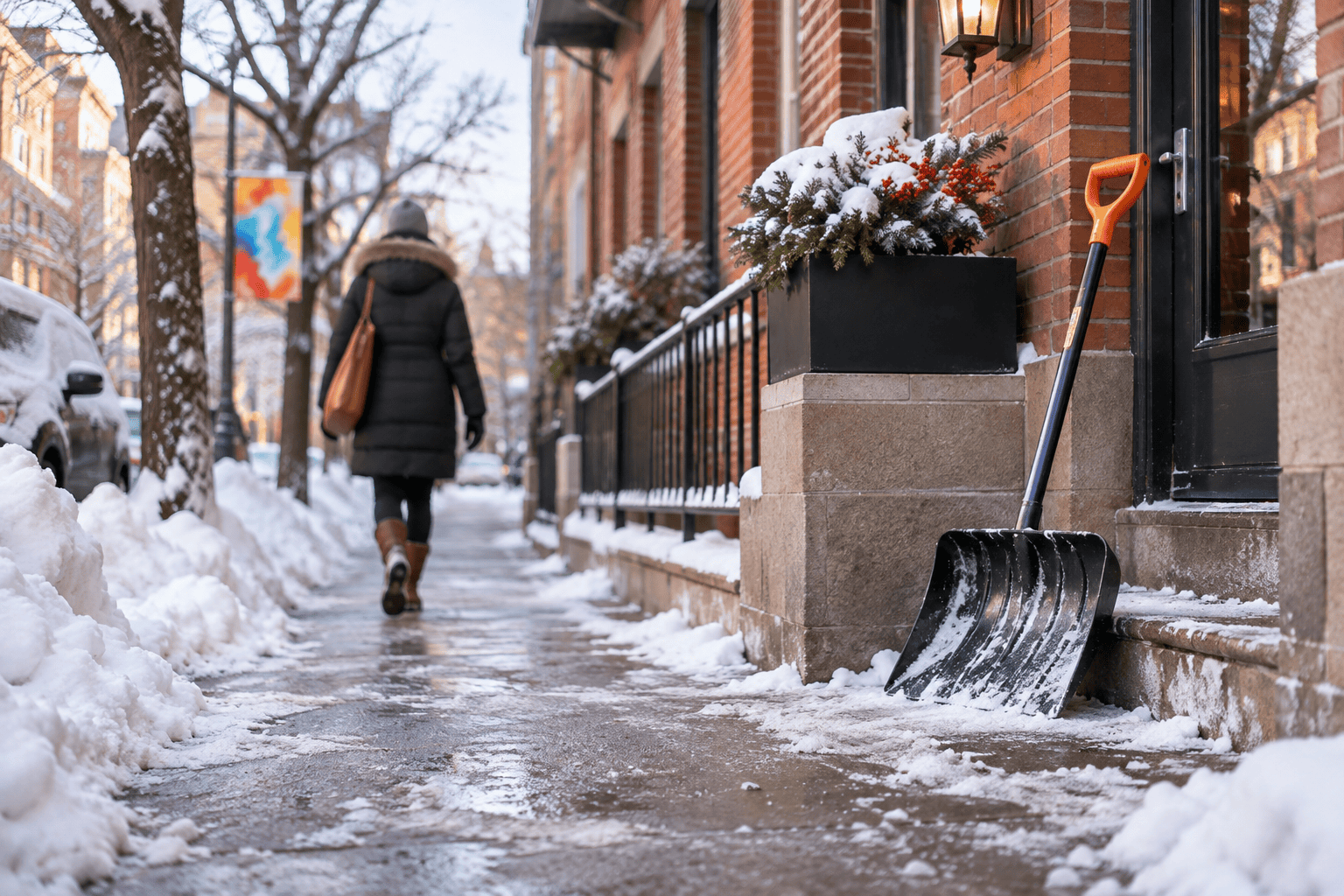
Under NYC snow removal rules, the property owner next to a sidewalk has four hours to clear it after daytime snow stops, and until the next morning after evening or overnight snow. The stop time also decides whether the “it was still snowing” defense applies, and that fact disappears as fast as the ice.
How long a property owner has to clear snow in NYC depends on the hour it stopped
Administrative Code 16-123, which the Department of Sanitation enforces, ties the deadline to the hour the snowfall ended. If snowfall ends between 7:00 a.m. and 4:59 p.m., the sidewalk must be cleared within four hours. If it ends between 5:00 p.m. and 8:59 p.m., the owner has fourteen hours. If it ends between 9:00 p.m. and 6:59 a.m., the sidewalk must be clear by 11:00 a.m.
The stop time matters more than the fine, because it also marks when the storm in progress defense begins to run out.
- Snow stopped at 2:00 p.m., sidewalk clear by 6:00 p.m.
- Snow stopped at 4:30 p.m., sidewalk clear by 8:30 p.m.
- Snow stopped at 6:00 p.m., sidewalk clear by 8:00 a.m.
- Snow stopped at 8:00 p.m., sidewalk clear by 10:00 a.m.
- Snow stopped at 11:00 p.m., sidewalk clear by 11:00 a.m.
- Snow stopped at 5:00 a.m., sidewalk clear by 11:00 a.m.

Shoveling is one law and paying for a fall is another
Who must clear an NYC sidewalk and who pays when someone falls are separate questions, answered by two sections of the Administrative Code.
Section 16-123 sets the clearing duty, backed by Sanitation summonses. Section 7-210 sets civil liability. According to NYC DOT, owners are potentially liable under section 7-210 for personal injuries caused by their failure to maintain the sidewalk. The owner, a tenant who controls a storefront, or a contractor who piled snow across the walk may each share responsibility.
The belief that homeowners never have to worry is wrong in both directions. Section 7-210 exempts one, two and three family homes that are at least partly owner occupied and used only as residences. That owner may still have to shovel and be ticketed, but faces different lawsuit exposure. A commercial building, a larger apartment building, or a small house the owner does not live in falls within 7-210. In a rental, a lease can split shoveling, but liability for an injury still depends on the statute and the facts.
The storm in progress rule protects owners only until the clock runs out
New York’s storm in progress rule generally shields a property owner from liability while snow is falling and for a reasonable time after it stops. Nobody can keep a sidewalk clear while snow keeps covering it.
Suppose the snow stopped at 8:00 a.m. and someone fell at 12:30 p.m. The daytime band gave the owner until 12:00 p.m., so the storm in progress argument weakens. A fall at 10:00 a.m., inside the open window, stands differently. “It was still snowing” carries less weight once the stop time is pinned down.
Old ice under new snow is not part of the new storm
Old ice under new snow can defeat the defense. If ice formed during an earlier storm or thaw and nobody treated it, fresh snow on top does not make it part of the new storm. The question becomes how long the old ice had been there.
Snow piled where it melts and refreezes across the walk
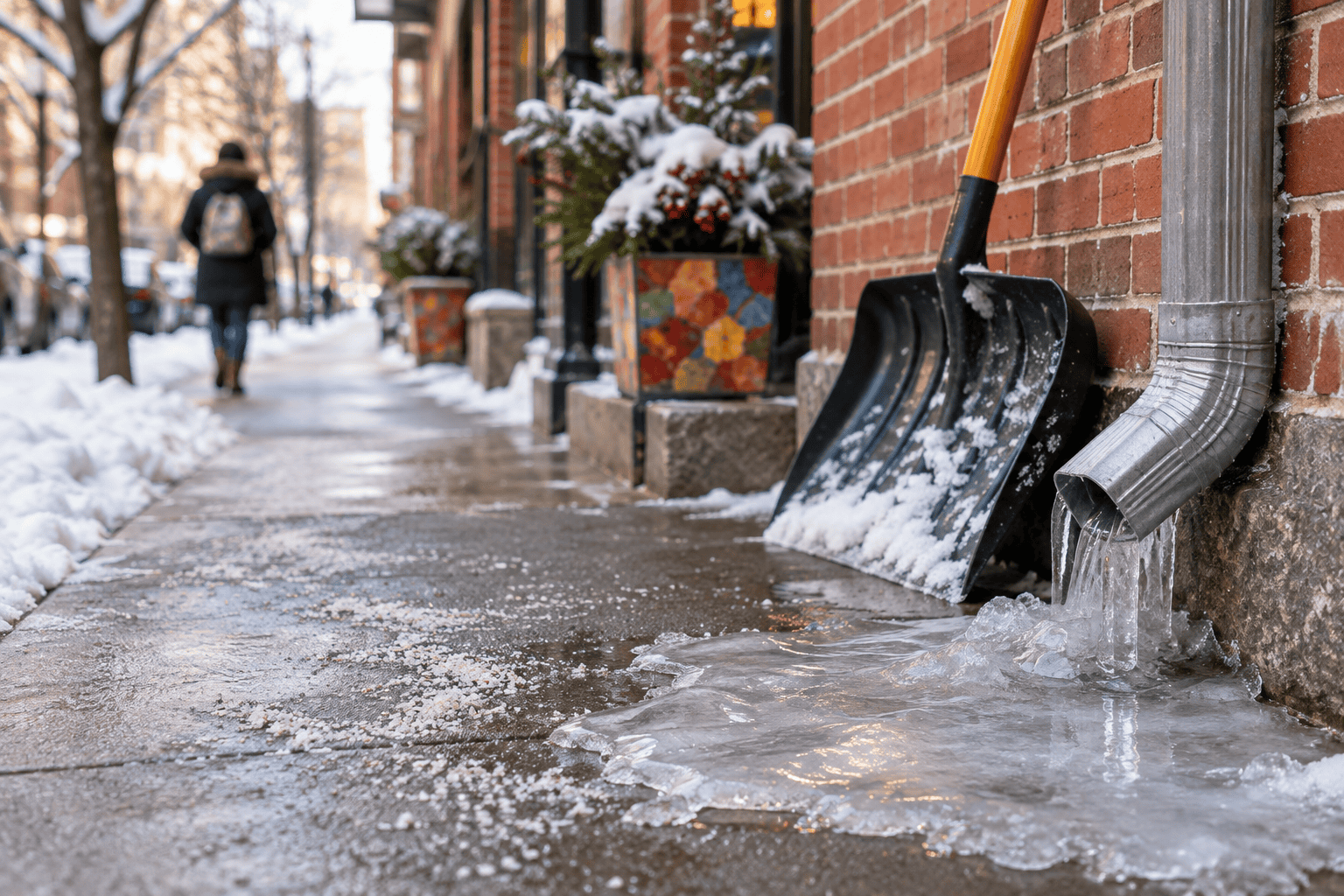
A snowbank atop a slope, a downspout emptying onto the sidewalk or a clogged drain can lay down fresh ice for days. Where drainage is disputed, an engineer can examine the building.
A half-cleared path can be more dangerous than an untouched one
A half-cleared path can leave a thin, packed layer that grows slicker than loose snow when nobody salts or sands it. An owner whose clearing made the condition worse may be responsible, even while the storm continues.
Accidents caused by black ice come down to notice and time
Black ice cases usually turn on whether the owner knew, or should have known, about the ice and had time to treat it.
Actual notice means the owner was told: a prior complaint, a tenant email, an earlier fall at the same spot. Constructive notice means the condition existed long enough that a reasonable owner would have found and treated it. Black ice is hard to see, so proof often comes from how long conditions lasted, not how the ice looked. People assume an “invisible” fall is nobody’s fault, but a gutter that drips onto the same square every cold night is a known condition.
Certified weather records settle the argument over when it stopped
Certified weather records show when precipitation started and stopped. Request them early, because that time drives the clearing window and the storm in progress defense. Suppose a building super remembers snow falling “until mid-morning.” The records show precipitation ended before dawn and the temperature dropped below freezing overnight.
That gap moves the owner’s deadline by hours. The records also show when temperatures crossed freezing, which proves overnight refreeze. Owners benefit too, because a timestamped photo of a cleared walk answers the question for them.
A fall on City, NYCHA or transit property can start a ninety day clock
If a public entity may be involved, the first deadline can be ninety days rather than three years. General Municipal Law 50-e requires a notice of claim within ninety days after the claim arises, and the ninety day notice of claim has its own requirements.
Under General Municipal Law 50-h, the City may examine the claimant at a 50-h hearing. If that examination is not conducted within ninety days of service of the demand, the claimant may commence the action. Administrative Code 7-201(a) requires that at least thirty days pass after the claim is presented to the Comptroller. General Municipal Law 50-i requires the lawsuit itself within one year and ninety days. Administrative Code 7-201(c)(2) adds a prior written notice rule for City sidewalks that are out of repair, unsafe, dangerous or obstructed.
Public authorities such as NYCHA and the MTA have their own notice requirements, so check the deadline right away. In fiscal year 2023, two thousand three hundred fifty sidewalk personal injury claims were filed against New York City, according to the NYC Comptroller. That count covers all sidewalk claims, not only snow and ice. People worry about whether they were careful enough, when whose sidewalk it was decides the clock.
Before the thaw, photograph and note these six things
Same-day photographs are the strongest record of an icy fall, because ice melts. Start with the surface, close up and then from a few steps back. Then capture the surroundings, with the building number, snow piles and any downspout in frame. Show the salt or sand, or the lack of it.
Photograph the shoes you were wearing, and keep them. Note the lighting, and if the fall happened at night, return at the same hour. Finally, write down the time and the names of any witnesses.
What injured New Yorkers ask after an icy fall
Does a Sanitation ticket for an unshoveled sidewalk prove the owner is liable for my fall?
Not by itself. A summons may be part of the evidence, while liability still turns on Administrative Code 7-210, notice and timing. Every case turns on its own facts.
Can you sue for slipping on ice in New York if you were partly at fault?
Possibly. Under CPLR 1411(a), an injured person’s own share of fault does not bar recovery, and damages are diminished in proportion to that share. Every case turns on its own facts.
How long do I have to bring a claim after slipping on ice?
Against a private owner, CPLR 214 generally allows three years. Against the City or a public authority, the ninety day notice of claim comes first. If the fall caused a death, EPTL 5-4.1 sets two years from the date of death.
What if I slipped on ice at work?
Notify your employer in writing within thirty days, as Workers’ Compensation Law 18 requires and the New York State Workers’ Compensation Board instructs. Notify the Board, normally by filing Form C-3, within two years of the accident, under Workers’ Compensation Law 28. A separate claim may exist against a property owner who is not your employer.
After a winter fall, get treated, write down the time, then find out whose sidewalk it was
Get medical care first. Report the fall in writing to the building, store or managing agent. Keep the shoes and clothing you wore, and note the time and the weather. Then find out whose property it was, because that decides which clock is running.

Caesar & Napoli checks that question first. Consultations are free and carry no obligation, and most personal injury cases are handled on a no-win, no-fee basis. The attorney you meet handles your case from beginning to end, in English or Russian. The main office is at 233 Broadway in the Woolworth Building, with offices in Queens and Brooklyn. Call (888) 235-6766, and if a cast or walker makes travel hard, say so and other arrangements can be discussed.
Related practice areas
Prior results do not guarantee a similar outcome. Every case is decided on its own facts. This article is general information and is not legal advice about any individual claim.
Image note: photographs accompanying our blog articles are illustrative and digitally created. They do not depict actual clients, actual attorneys of this firm, or actual events.
Read more
E-Bike, Scooter and Bicycle Accidents in New York City: Who Pays
After most e-bike accidents in New York, the no-fault insurer of the car, truck or bus that hit you pays first. That coverage pays medical bills and part of lost pay up to fifty thousand dollars under Insurance Law 5102(a), but nothing for pain, which takes a lawsuit, a serious injury and a share of […]

Brain Injury From a Hospital Mistake in New York: What a Malpractice Claim Must Prove
Yes, you can sue a New York hospital for a brain injury when hospital negligence, a departure from accepted practice, caused the loss of oxygen. Most hospitals allow two years and six months under CPLR 214-a. An NYC Health + Hospitals facility requires a notice of claim within ninety days under General Municipal Law 50-e. […]

Hit by an MTA Bus in New York City: The Ninety Day Rule You Cannot Miss
An MTA bus accident settlement starts with a notice of claim served on the right bus operator within ninety days, under General Municipal Law section 50-e. “MTA” covers more than one bus operator, and the operator decides where the notice goes. The notice of claim is due ninety days after the accident, and it must […]