
What’s Wrong With New York Hospitals?
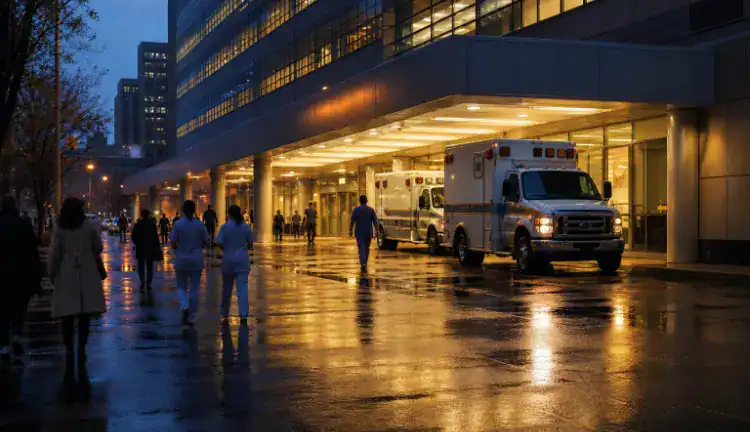
When an ultrasound exposed a fibroid tumor growing in her uterus, Elissa McMahon didn’t take any chances.
Though she is a Massachusetts resident, Elissa scheduled a surgery to remove the fibroid at Lennox Hill, a top hospital in New York, where she would be close to her family. The surgery was a success, and Elissa was relieved when the pathology tests came back negative. She was cancer free, so the hospital said. This was in January 2012.
Two years later, Elissa began to experience severe back pain. She checked into an emergency room, where doctors found a tumor on her spine and metastatic lesions in her liver. Elissa had stage-4 cancer in her uterus, back, and liver.
Elissa’s diagnosis left her with little time to live, and without the money to support her teenage son.
“The cancer has made it impossible for me to work. I worry every day and every night about what funds will be there to care for my son — to pay for his college — when I can no longer be here to help him,” she said.
When Elissa visited the Dana-Farber Cancer Center in her area, an oncologist reviewed the pathology slides taken two years earlier. Though the doctors at Lennox Hill had told Elissa that she was cancer-free, her cancer was visible in ten out of the forty slides.
The law protects victims of medical malpractice. If Elissa’s surgery had taken place in her home state of Massachusetts, or in the vast majority of US states, she would be well within her rights to file a lawsuit against Lennox Hill for incorrectly reading her pathology slides.
However, New York is one of six states that impose statutes of limitations on medical malpractice lawsuits based on the date that the malpractice occurred, rather than the date it was discovered. In Elissa’s case, her ability to sue Lennox Hill expired months before her cancer diagnosis.
“I was told that the window of time that I would have had to seek restitution for this mistake closed before I even knew I had cancer,” Elissa said.
New York’s law creates extreme hardship for people like Elissa, whose only mistake was not seeking medical care in another state.
Lavern’s Law—named after Lavern Wilkinson, a Brooklyn single mother who died in 2013 after doctors failed to identify evidence of her curable lung cancer—offers hope to victims of medical malpractice. If passed, the bill would set the statute of limitations on medical practice cases based on the date of discovery, rather than the date of the malpractice.
Lavern’s Law has the support of Governor Cuomo as well as the State Assembly. However, last year it failed to pass in the Republican-controlled State Senate.
It is hard to believe that New York is so far behind other states in protecting medical malpractice victims and their families. Without Lavern’s Law, innocent New Yorkers will continue to suffer, through no fault of their own.
“Even if my son can’t benefit from this, there are other people in similar situations,” said Elissa.
Sources:
Berg, David, “Massachusetts Medical Malpractice Laws & Statutory Rules,” AllLaw.
Dahlem, Liz, “Cancer patient can’t sue hospital under current NY law,” Fox 5 News, 24 May 2016.
McMahon, Elissa M., “Medical Suits Need More Time,” Times Union, 31 May 2016.
Schapiro, Rich, “Cancer patient who can’t sue after misdiagnosis because of statute of limitations says she wants lawmakers to pass Lavern’s Law,” New York Daily News, 25 May 2016.
Related Practice Areas
Image note: photographs accompanying our blog articles are illustrative and digitally created. They do not depict actual clients, actual attorneys of this firm, or actual events.
Read more

E-Bike, Scooter and Bicycle Accidents in New York City: Who Pays
After most e-bike accidents in New York, the no-fault insurer of the car, truck or bus that hit you pays first. That coverage pays medical bills and part of lost pay up to fifty thousand dollars under Insurance Law 5102(a), but nothing for pain, which takes a lawsuit, a serious injury and a share of […]

Brain Injury From a Hospital Mistake in New York: What a Malpractice Claim Must Prove
Yes, you can sue a New York hospital for a brain injury when hospital negligence, a departure from accepted practice, caused the loss of oxygen. Most hospitals allow two years and six months under CPLR 214-a. An NYC Health + Hospitals facility requires a notice of claim within ninety days under General Municipal Law 50-e. […]

Snow and Ice Falls in New York City: Who Had to Clear It and When
Under NYC snow removal rules, the property owner next to a sidewalk has four hours to clear it after daytime snow stops, and until the next morning after evening or overnight snow. The stop time also decides whether the “it was still snowing” defense applies, and that fact disappears as fast as the ice. How […]